
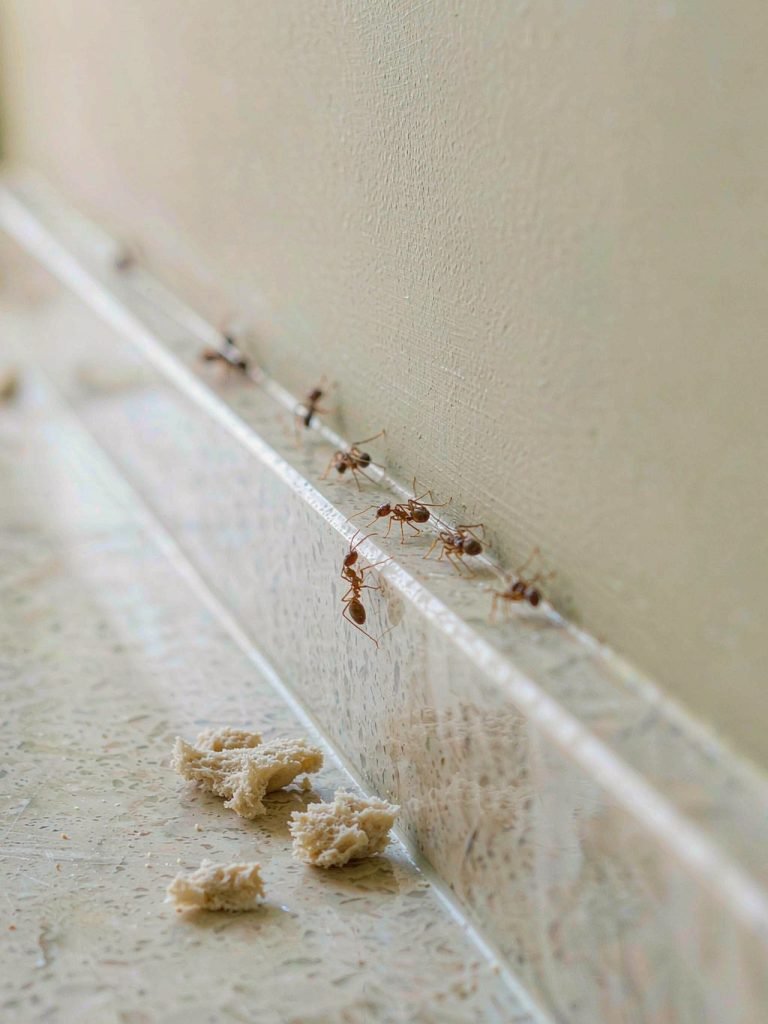
Most ants defend a territory against outsiders. Argentine ants do the opposite. They form supercolonies — networks of nests that share workers and accept each other — and in parts of California one colony is documented running for more than 900 kilometres.
Why the usual advice fails
Spray a trail and you kill the foragers, not the colony. The survivors raise an alarm, the nest splits, and you get two nests where there was one. This is called budding, and it is why ant problems often get worse for a month after a professional-looking spray job.
How the colony reproduces
Unlike most ants, Argentine queens do not need a mating flight. A queen can leave on foot with a handful of workers, establish a satellite nest and start laying. A single colony may hold dozens to thousands of queens, so removing one changes almost nothing.
A queen lays roughly 30 eggs a month in warm weather. Brood develops in about 30 to 60 days depending on temperature, and workers live for several months. The colony does not have a single annual brood pulse; it produces new workers continuously, which is why baiting has to run long enough to reach the larvae being fed right now.
How they behave
Argentine ants follow scent trails along edges — skirting boards, tile grout, the rim of a sink. They farm aphids and mealybugs for honeydew and defend those insects from predators, which is why an ant problem in the kitchen often starts with a plant by the window.
They also seek moisture. In dry weather they move indoors for water, not food. A bait that only offers sugar will be ignored during a hot, dry week.
What actually works
- Non-repellent liquid bait. Slow-acting and transferable, so foragers carry it back and share it. Place stations every two to three metres along the trail.
- Protein first, sugar second. When the colony is producing brood, they want protein. Switch the bait matrix when acceptance drops.
- Patience. Two to six weeks. Killing fast defeats the purpose: the foragers must survive long enough to feed the queens.
- Remove alternative food. Pet bowls, dripping taps, compost. A bait competes with everything else on the counter.
What to avoid
Repellent sprays, diatomaceous earth dusted across the trail, and vinegar washes. All three interrupt the trail without reducing the colony, and all three encourage budding.
The check
Watch a trail for one minute and count the ants crossing a marked point. Do this every third day. A falling count means the bait is being shared. A steady count with dead ants at the station means the active ingredient is repellent, and you need a different formulation.