
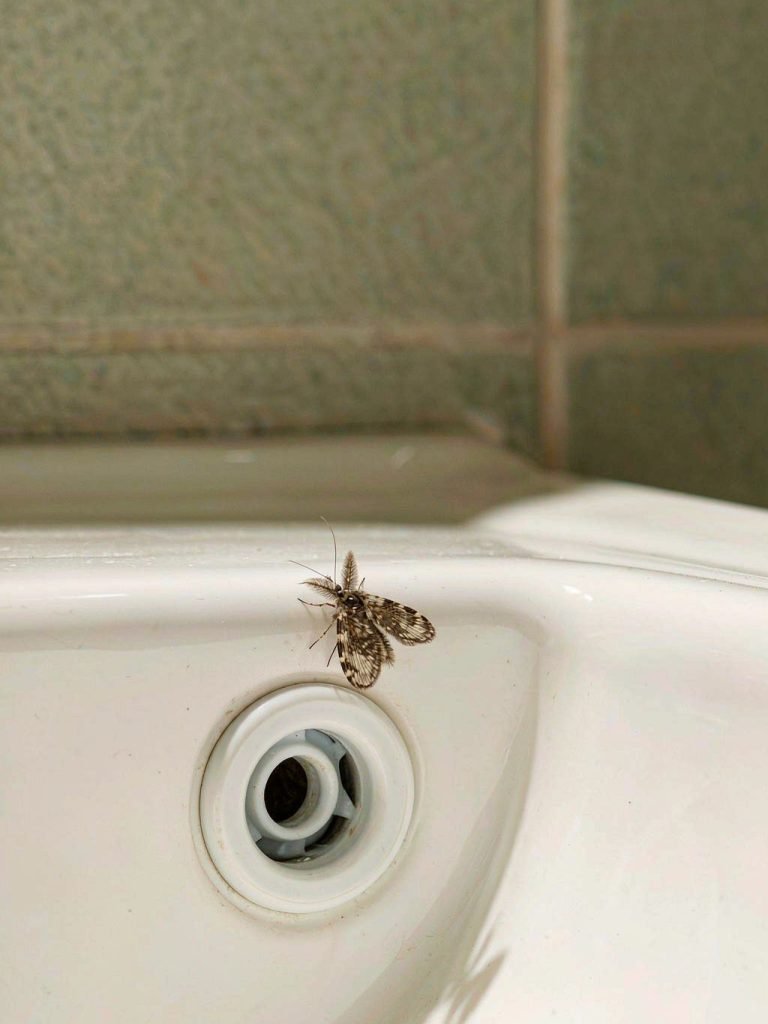
Small, dark, moth-like insects hovering over the bathroom sink. People call them fruit flies and put out a vinegar trap. It catches nothing, because drain flies — family Psychodidae — do not care about vinegar. They are breeding in the pipe.
How to tell them apart
Fruit flies (Drosophila) are 2–3 mm, tan with red eyes, and fly with a steady hover around fruit, bins and beer taps. Drain flies are 2–5 mm, grey-black, and hold their wings in a heart shape over the body. They fly in short, erratic hops and land on walls near drains.
The decisive difference is where they are coming from. If crushing one leaves a dark smudge of scales, and the bathroom is the hotspot, it is a drain fly.
Where they breed
In the gelatinous biofilm that coats the inside of a drain — a mix of hair, soap, skin cells and bacteria. The larvae live in that film, breathing through a siphon tube, and feed on it for one to three weeks before pupating.
Look beyond the sink: overflow holes, the gap around a loose drain flange, a floor drain in a utility room, a shower trap that is never used, a leaking pipe in a cabinet, and the drip tray under a refrigerator.
The fix is mechanical, not chemical
- Scrub the biofilm. A bottle brush down the drain, plus an enzyme drain cleaner that digests organic film. Repeat weekly for a month.
- Boiling water. A kettle of boiling water down the drain once a week helps, but it does not remove the film on its own.
- Seal gaps. Re-caulk a loose drain flange and cover unused floor drains with a tight grate.
- Fix the leak. A dripping trap under the sink keeps the film alive no matter how often you clean.
What does not work
Bleach. It kills the top layer of biofilm and leaves the rest, and the surviving larvae pupate a week later. Aerosol sprays kill adults on the wing but do nothing to the larvae. Vinegar traps work on fruit flies and are useless here.
If they persist
If the drain has been scrubbed and the flies still appear, the source is downstream — a broken pipe under the floor, a sump, or a septic tank vent. That is a plumber’s problem, not a pesticide problem, and no amount of spraying will fix it.