
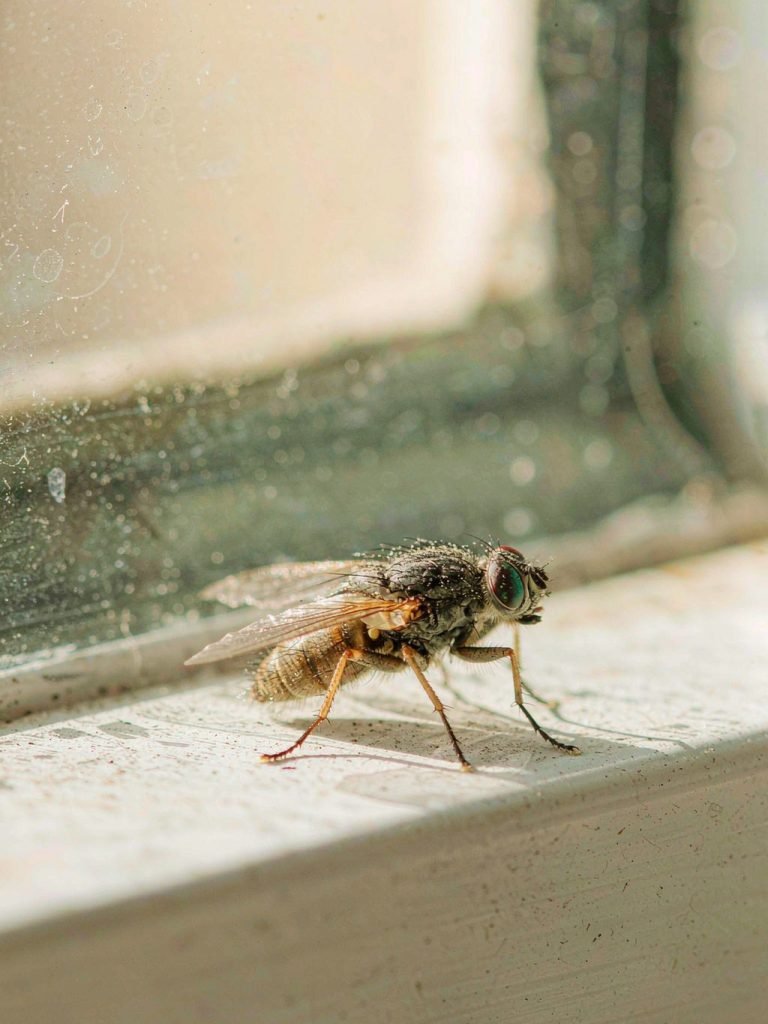
House flies have chemoreceptors on their tarsi — the last segments of the leg. They taste by walking. That is why a fly circles a plate, lands, takes a few steps and leaves: it is sampling the surface, and it decides whether to feed or move on.
How fast they build a population
A female lays 75–150 eggs per batch, in five or six batches, on moist organic matter — garbage, manure, compost, a dead rodent in a wall. Eggs hatch in 8–24 hours. The larva, a maggot, feeds for four to seven days, then pupates for three to six days. In summer, egg to adult takes 7–10 days.
Adults live two to four weeks. That short life is the reason a fly problem appears suddenly: a bin left unemptied for a week can produce a thousand adults in the following week.
Why they matter
A house fly moves between waste and food, and it does so without cleaning. Its body hairs trap particles; its habit of regurgitating saliva onto food before feeding and defecating while it eats transfers bacteria. Shigella, Salmonella, E. coli and Campylobacter have all been recovered from house flies in field studies.
What actually works
- Remove the breeding site. This is the only step that reduces the population. Bin liners tied shut, bins emptied twice weekly in summer, compost turned and covered.
- Exclusion. Fly screens on windows, a self-closing door, brush strips. A fly inside is a fly that found a gap.
- Sticky traps and UV traps. Useful indoors where breeding sites are gone. Place them away from food preparation and at the height flies rest — usually 1.5–2 m.
- Residual spray on resting surfaces. Door frames, window edges, bin surrounds, the shaded side of a wall. Flies rest on edges, not open surfaces.
What does not
Fly swatters and aerosols kill the flies you can see. They do not touch the larvae in the bin. Meanwhile, a fly population can double in a week, so removal at the source is the only arithmetic that keeps up.
The three-site check
When flies persist, walk the property and find the source: the bin, the compost, the pet waste, the drain, or something dead. Nine times out of ten it is one of those five. Find it, remove it, and the adults disappear within a fortnight as they die off and are not replaced.